Page 222 of 230

Mixed reviews on the government’s cash for clunkers program

shutterstock_1433024

Many are hopeful that the federal government’s new cash for clunkers program will provide a much-needed boost to the American auto industry at a time when the recession is crushing auto sales. BusinessWeek, however, calls the new program a “lemon.”

The problem with the law is that it is both underfunded and too narrow to generate a spike in showroom traffic. Standard & Poor’s (MHP) says the most it will do is boost sales by 3% for the year; a similar German program pushed sales up 30% a month this year. “This is a waste of taxpayers’ money,” says analyst John Wolkonowicz of Boston research firm IHS Global Insight (IHS). “There won’t be enough people who can take advantage of it.”

First off, the feds have approved only $1 billion for the program. That could help fund the purchase of just 250,000 cars—not much more than a week’s worth at current sales levels—between August, when the program likely will start, and Nov. 1, when it ends.

Plus, the law makes little sense for most passenger-car owners. The government will cut checks of $3,500 to $4,500 to dealers so they can buy old cars that get 18 miles per gallon or less and then sell the owner a more fuel-efficient replacement. But most cars on the road get more than 18 mpg, so they won’t qualify. And many that are thirsty enough to warrant the deal are luxury models worth a lot more than $3,500 to $4,500. If a consumer can sell the old car for more than what the government will pay, there’s no reason to take advantage of the bill, says Wolkonowicz.

Yes, there are plenty of old cars that do qualify. But many are 10 years old or more, says Edmunds.com CEO Jeremy Anwyl. People driving cars that ancient often buy used, and even with a $4,500 discount, they probably won’t want to take on new-car payments during a time of economic hardship.

This is a pretty downbeat view. The article points out that the program should be bigger, but if it’s successful you can be sure that Congress and the Obama administration will push to expand it.

Reuters takes a much more positive view, pointing out that the law is spurring certain buyers to trade in old vehicles.

Having driven the equivalent of six smoke-belching laps of the planet, Tony Metzler figured his ageing Chevrolet Blazer SUV would not make a good trade for a new car. Until now that is.

With a $1 billion (621 million pounds) federal “Cash for Clunkers” program that pays consumers $3,500 or $4,500 in credit to swap ageing gas-guzzlers for new, more fuel efficient models, he made the plunge.

“It ended up being right place, right time for me,” said Metzler, 42, who traded his eight-year-old sport utility vehicle for a new Chevrolet Equinox this week. “It seemed like a good opportunity.”

The program signed into law by President Barack Obama in June offers a trade-in credit of up to $4,500 to owners of cars built since 1984, with fuel economy of 18 miles per gallon or less.

It also applies to SUV, vans and pickup trucks. Participating dealers assess the discount, apply it to the new vehicle, and then obtain reimbursement from the government. Details of eligibility are available at www.cars.gov.

Metzler, a Phoenix-valley insurance executive, had racked up 150,000 miles (240,000 kilometres) in his old SUV that averaged 17 miles per gallon. He got a $3,500-credit towards his new car, which gets a slender 3 mpg improvement.

The program, which backers hope will arrest the auto industry’s slide and sell 250,000 new vehicles this year, runs through November 1 or until funds are exhausted. It has been broadly welcomed by auto dealers across the country.

For more information on the program, check out Cash for Clunkers Facts.

Hummer might move to Tennessee

shutterstock_16675234

Fritz Henderson said today that the deal to sell the Hummer brand is proceeding.

“The purchaser for Hummer is going through the approval processes in China,” Henderson said. “We’re cooperating with them. The purchaser is professional, well-advised and has done a huge amount of work. We’re supporting the process. Our expectation is that this deal can get done.”

Sichuan-based Tengzhong, a Chinese firm that builds heavy-duty commercial vehicles, is in the process of buying Hummer. Earlier, in a live Web chat on the GM FastLane blog in early June, Henderson said Tengzhong “offered the best overall alternative, and we did not have (a) broad portfolio of other buyers.”

Meanwhile, Hummer is checking out locations for its new headquarters.

Hummer, the sport utility vehicle manufacturer in the process of being spun off by General Motors, has had early discussions with Williamson County officials about relocating the company’s headquarters here, officials said.

In late June, Hummer Chief Executive Officer Jim Taylor said in an interview the company was examining the areas around Detroit as well as Nashville for the possible site of its new corporate headquarters.

Nick Richards, Hummer spokesman, confirmed this week that the automaker has had preliminary discussions with Williamson County economic development officials.

“We’ve had some initial discussion with folks in Williamson County but it’s too early to say what our plans are,” Richards said. “Right now we’re looking at all viable options for the future Hummer headquarters.”

Matt Largen, county economic development director, confirmed the recent discussions though he declined to provide details.

Chinese manufacturer Sichuan Tengzhong Heavy Industrial Machinery Co. is slated to buy the General Motors unit in a deal some expected to be finalized later this year. That deal still needs a final sign-off from the Chinese government and recent reports say China’s state planning agency might reject the deal because Hummer doesn’t fit Beijing’s gas-conservation goals for vehicles.

Moving away from GM means Hummer must find separate corporate offices.

It will be interesting to see what happens to this once-hot brand that represents many of the problems facing the U.S. auto industry which focused too much on gas-guzzling vehicles. In an era of higher gas prices and a major recession, do vehicles like the Hummer H3T pictured above have a future? Of course it can possibly survive as a niche brand, but it will be interesting to see how the brand evolves under new ownership in this new environment.

The “new GM” is here

2010-chevy-camaro-3

The new General Motors Company has emerged from bankruptcy, and CEO Fritz Henderson is making plenty of changes.

Fritz Henderson’s remarks this morning on General Motors’ speedy exit from Chapter 11 bankruptcy were a pretty sweeping condemnation of the old GM’s culture and structure.

His decision to sweep away entire layers of regional management, and eliminate the entire group running the North American business and taking charge himself, suggest there was a lot of redundancy.

Of course, the fact that GM is selling its Opel operations in Europe and will only retain a minority stake makes a coherent global structure more difficult. But Mr Henderson is making the best of a bad job by giving Nick Reilly the job of running international operations from Shanghai.

The theme of reducing the amount of time spent talking and prevaricating in meetings is common to GM and Ford, where Alan Mulally has made much of his effort to speed up decision-making.

Henderson also announced a new partnership with eBay to sell cars by auction online. Nobody seems to know precisely how this will work, but the symbolism is clear – GM will be innovative in the future with respect to all aspects of the car business.

Bob Lutz has also decided to stay on and postponed his retirement.

In addition to hailing the closure of the deal, chief executive Fritz Henderson outlined several changes to GM’s management, including the “un-retirement” of vice chairman Bob Lutz to oversee most creative work at the company, including global design, advertising and communications.

Lutz is a great car guy, so this is a good thing, but I wonder about putting him in charge of marketing. GM’s marketing in the past has been horrible. They wasted huge dollars on old-school sponsorships, and the have not been a leader online. GM has stated that it is more committed to online advertising, but it remains to be seen how much an old-school guy like Lutz understands new media.

The bold new look of the 2010 Jaguar XJ

2010_jaguar_xj

As you can see from this photo, the 2010 Jaguar XJ is a gorgeous car. The company seems committed to bold, new designs, and even the official Jaguar web site is beautifully designed.

Reactions are coming in from the auto press. Car and Driver proclaims, “At last, a Jaguar XJ that doesn’t resemble the one that came before. And before. And before.”

Back in April, Jalopnik had this to say:

The current XJ, on sale since 42 AD, is a bloated attempt to pack modern luxury into an outdated design. If this shot is anything to go by, the 2010 Jaguar XJ isn’t. Hallelujah.

Jaguar released this image to coincide with the Shanghai Auto Show, but the car itself will actually be unveiled on the Queen’s soil on July 9th. Available with the pictured panoramic glass roof, a long or short wheelbase, A Europe-only V6 diesel or Jag’s usual selection of 5.0-liter V8s; the supercharged 2010 Jaguar XJR will produce 510 HP. Sales should start at the end of 2009.

The New York Times reported today on the unveiling of the new Jaguar today.

Jaguar has two emblems, and each is a version of its totemic animal. Their informal names, the Leaper and the Growler, suggest two aspects of the British company’s tradition. The Leaper is a long, lithe cat, usually seen as a hood ornament; it signifies feline grace. The Growler is a full-frontal cat face, its teeth bared aggressively; it represents raw power.

The Growler may be supplanting the Leaper at Jaguar, to judge from the company’s redesigned and radically different flagship sedan, the XJ, which was unveiled in London on Thursday.

The new XJ replaces a sedan — or saloon, as the British charmingly call it — whose basic shape had not changed since 1968. The old car’s proportions were like nothing else still on the road; it appeared as long and stately as its bloodline.

“The XJ completes the family,” Ian Callum, Jaguar’s design director, said in a telephone interview before the unveiling. The big sedan carries out design themes that Mr. Callum introduced on the 2007 XK sports car and on the 2009 XF midrange sedan.

Jaguar also has a new owner, Tata Motors of India, which bought the marque, along with Land Rover, from Ford last year. Jaguar’s ill-fated venture into cheaper cars, with the X-Type line based on the Ford Mondeo, is history. And in recent years Jaguar has vastly improved its ratings in consumer quality and satisfaction surveys by J. D. Power & Associates and others.

The new sedan has a Growler, not a Leaper, on the front. “Aggressive” is the word Mr. Callum kept using to describe the design. “We want Jaguars to be noticed again,” he said.

Kudos to Tata Motors and Mr. Callum on an elegant but powerful design worthy of this great brand.

Toyota’s new boss speaks with Fortune

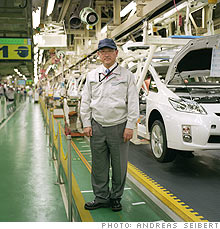
Toyota’s new President is starting at the time when the mighty Toyota is having uncharacteristic problems. Toyota’s U.S. sales tanked in June, and for the first six months of 2009 Toyota was outsold by Ford in the United States.

Fortune spoke with Akio Toyoda about his vision for Toyota’s future.

Even though he has the same last name as five of the 10 previous presidents of Toyota Motor, Akio Toyoda is nothing like his predecessors.

Item: He has spent seven years in the U.S., holds an MBA, and speaks flawless English.

Item: He likes to race cars and just completed a 24-hour endurance competition with three other team members in a Toyota supercar at Germany’s famed Nürburgring.

Item: At age 53 he is 14 years younger than the man he is succeeding, and he believes that his relative youth “can make a unique contribution” to the company.

Toyoda takes office two months after Toyota reported the biggest annual loss in its history — $4.4 billion. He thinks that his family’s company — at last count, the Toyoda clan owned approximately 2% of the stock — suffered because of a “once-in-a-century crisis” brought on by the global economic slowdown, as well as Toyota’s own internal problems, some of them at its U.S. operations. He vows to rein in overcapacity, reorganize operations to strengthen control, and get the company back to basics. He especially wants to reinstill dedication to one of the pillars of Toyota’s production system: genchi genbutsu, meaning “go and see for yourself.”

Akio Toyoda is a grandson of Toyota’s founder, Kiichiro Toyoda (the family changed the spelling of the company’s name for greater euphony) and the son of Shoichiro Toyoda, now honorary chairman. After getting a law degree from prestigious Keio University, he went to the U.S., where he received an MBA from Babson College (the alma mater of another auto scion, Edsel Ford II). He joined Toyota in 1984 and returned to the U.S. for a two-year stint as head of NUMMI, the California plant that is a joint venture with General Motors. At ultraconservative Toyota, Toyoda is considered a bit of a radical. In the early part of this decade he headed the development team for an Internet venture, Gazoo.com, which provides information on new and used vehicles and which morphed into a lifestyle cybermall.

If you read the actual interview, he doesn’t sound like much of a radical, but it looks like some changes will be in order under his leadership.

« Older posts Newer posts »

© 2026 Dashboard News

Theme by Anders NorenUp ↑